
Rental Car Border Crossing: Permission, Documents, and Coverage
On this page
Quick answer
Do not take a rental car across an international border until the rental company gives written authorization for the exact vehicle, driver, countries, dates, and route. Confirm entry documents, driver licensing, locally valid insurance, roadside assistance, tolls, and return terms separately. Carry the signed rental agreement and authorization, and recheck official border information before departure.
Get written rental-company permission
A vehicle available for rent is not automatically authorized for every country. Restrictions can depend on the pickup location, vehicle class, destination, one-way plan, driver age, and length of stay. Ask the rental company—not merely a travel forum or comparison site—to confirm the exact trip.
- Name every country to be entered or transited.
- List all authorized drivers and travel dates.
- Confirm whether ferries, remote regions, or unpaved roads are restricted.
- Ask about permits, border letters, deposits, and cross-border fees.
- Verify whether the car must return to the original country and branch.
U.S. Customs and Border Protection says a driver of a rental vehicle needs written authorization from the rental company to take it into another country. Save the final permission with the signed agreement.
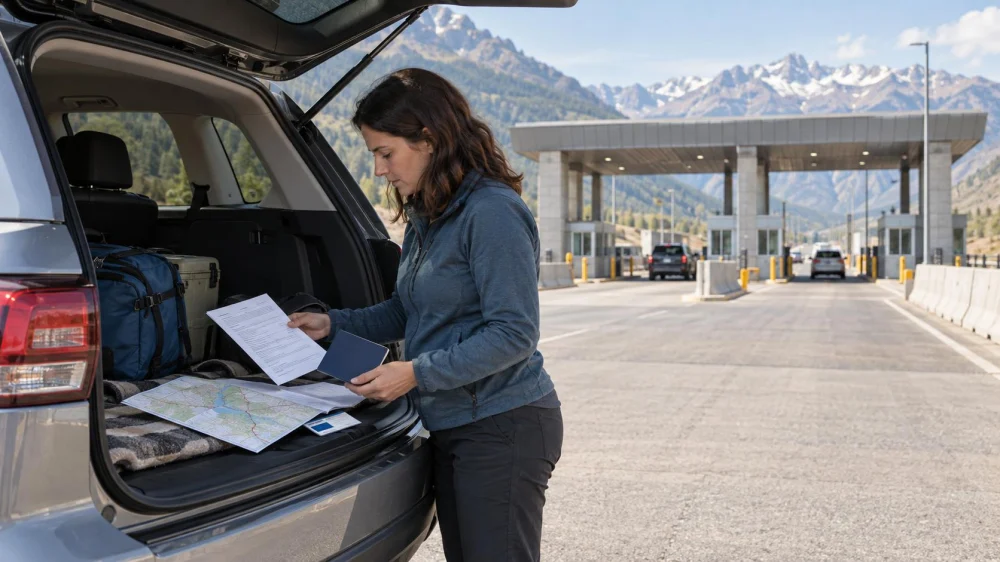
Build a border document set
Requirements vary by traveler, destination, and route. Check the official border and travel sites for each country, including any country you will only transit. Common documents may include a passport or other accepted entry document, visa or travel authorization, driver’s license, International Driving Permit where required, rental agreement, company authorization, registration copy, and proof of insurance.
An International Driving Permit translates license information; it does not replace the original license. Obtain it only from an authorized issuer before travel. Each traveler needs the documents required for their own status, and a trusted-traveler lane may have separate rules for every occupant.
Verify insurance and assistance
Check territory, exclusions, limits, deductibles, and required proof for every country. A personal auto policy, card benefit, or rental protection that applies at home may exclude foreign travel or fail to meet local minimums. The U.S. Department of State advises travelers to confirm whether their insurance is valid abroad and sufficient under local requirements.
- Get written confirmation from the insurer or benefit administrator.
- Ask whether liability, collision damage, theft, glass, tires, towing, and loss of use are covered.
- Confirm how to reach roadside assistance from another country.
- Record police-report and claims requirements.
- Carry the insurance document in the format the destination accepts.
Do not assume an insurance card proves the rental contract permits the trip; permission and coverage are separate checks.
Plan the route and return
Use open official ports of entry and check operating hours, vehicle lanes, appointment systems, road rules, winter-equipment rules, toll systems, low-emission zones, and fuel availability. Build time for inspection and document review.
Confirm whether the return branch accepts a foreign-country arrival, whether a one-way international return is allowed, and how late arrival or a border closure affects the contract. Save branch phone numbers and written instructions for a breakdown, collision, theft, impound, or lost key across the border.
Confirm everything at pickup
At the counter, disclose the border trip again. Make sure the final signed agreement does not contradict earlier emails. Check the vehicle identification details on the authorization, inspect required documents, and ask staff to correct omissions before you leave.
- Photograph the signed agreement and authorization.
- Verify all drivers are listed.
- Confirm allowed countries and prohibited areas.
- Check insurance proof and emergency contacts.
- Inspect the vehicle and record existing damage.
- Store paper and offline digital copies separately.
If the assigned vehicle class or plate changes, ask whether the authorization must be reissued. Never alter a letter yourself.
Frequently asked questions
Is a verbal “yes” from the desk enough?
No. Ask for authorization in writing and ensure the final rental contract permits the trip.
Does my U.S. license work everywhere?
No. The destination may require an International Driving Permit or other documentation in addition to your valid license.
Can I buy insurance at the border?
That may be possible on some routes, but do not rely on it. Confirm legal minimums, rental terms, and accepted proof before travel.
What if I cross without permission?
You may violate the rental agreement and risk denial of assistance or protection. Stop and obtain written confirmation before crossing.
Do passengers need documents too?
Yes. Each occupant must meet the destination’s entry rules, and special lanes or programs may impose additional requirements.
Conclusion and next steps
Write the complete route, ask the rental company for vehicle-specific authorization, and verify official entry, license, and insurance rules. Compare those answers with the final contract at pickup. Carry the signed documents and emergency contacts, and do not cross if permission or coverage remains uncertain.
Evidence note: This checklist references current guidance from U.S. Customs and Border Protection on rental-vehicle authorization and the U.S. Department of State’s Driving and Transportation Safety Abroad. Rules and contracts can change, so verify the exact trip.





 MK Car Rental, LLC5.0 (4 reviews)
 Avis Car Rental3.0 (230 reviews)
 United Auto Rental4.0 (186 reviews)
 COLUSA RENT A CAR4.0 (1004 reviews)
 HH Management Rental Cars5.0 (18 reviews)
 TeslaRents4.0 (116 reviews)
 Best Fuel Saving Tips When Driving a Rental Car for Smart Travel
 Can You Extend Budget Car Rental at Hilo Airport? Tips for a Hassle-Free Experience
 A+ Car Rental: Your Guide to Convenient and Affordable Car Rentals
 How to Avoid Overpaying for Car Rental Extras
 How to Rent a Car for a Long-Term Business Stay in the US
 Do Credit Cards Cover Car Rental Insurance? What You Need to Know