
Rental Car Child Seats: Verify Fit Before You Drive
On this page
Quick answer
Before renting a car with a child seat, confirm the exact seat type, availability, daily charge, vehicle compatibility, installation responsibility, and replacement process. At pickup, inspect the seat, find its labels and instructions, verify all parts are present, install it before loading luggage, and check the fit for the child. Do not drive when the seat is damaged, expired, recalled, incomplete, or cannot be installed correctly.
A rental child restraint is a rear-facing seat, forward-facing seat, combination seat, or booster supplied temporarily with a rental vehicle. The correct choice depends on the child's size and developmental needs, the restraint limits, vehicle seating position, and current law—not simply the child's age.
Plan before booking
Child-restraint laws vary across the United States and can apply where the vehicle is driven, not just where it is rented. Check current official guidance for every state on the route and follow the restraint and vehicle manufacturers when their limits are more protective.
- Ask whether the seat request is guaranteed or subject to availability.
- Request the restraint category and limits, not a vague promise of a “car seat.”
- Confirm daily and maximum fees, taxes, deposits, and refund terms if no suitable seat is available.
- Ask whether staff install the seat, assist only, or leave installation to the renter.
- Verify the reserved vehicle class can accommodate the number of restraints and passengers.
- Plan an alternative, such as traveling with your own known-history seat, if supply or fit is uncertain.
Record the reservation details and contact the pickup location shortly before arrival. Fleet and accessory availability can change, so a booking note may not identify the exact model waiting at the counter.
Bring your seat or rent one
Bringing your own restraint provides known history, familiar installation, and known fit for the child. The tradeoffs are transporting a bulky item, protecting it from damage, and complying with airline handling rules. Inspect it after travel before use.
Renting avoids carrying the seat but can introduce uncertainty about model, cleanliness, history, instructions, and availability. A rental company should have a process for inspection and replacement, but the driver still needs to confirm that the provided restraint is appropriate and installs securely.
A used seat with unknown crash history, missing labels, absent instructions, damaged shell, frayed harness, or incomplete parts is not a good compromise. Ask for another seat or vehicle, use your backup plan, or delay departure.
What to check at pickup
- Identify the seat. Find the manufacturer, model, date label, size limits, and expiration or useful-life information.
- Find the instructions. Obtain the restraint manual and the rental vehicle manual. A QR code is useful only if you can verify the official source and maintain access.
- Inspect every part. Look for cracks, stress marks, deformation, loose foam, frayed straps, sticky adjusters, missing covers, missing clips, and damaged connectors.
- Ask about history. Confirm the rental company's process for removing seats after crashes, recalls, expiration, or contamination.
- Check cleanliness safely. The cover should be clean and dry, but unapproved replacement padding or harsh chemical residue can also be a concern.
- Confirm the vehicle. Make sure the intended seating position has the belt or lower-anchor and tether setup permitted by both manuals.
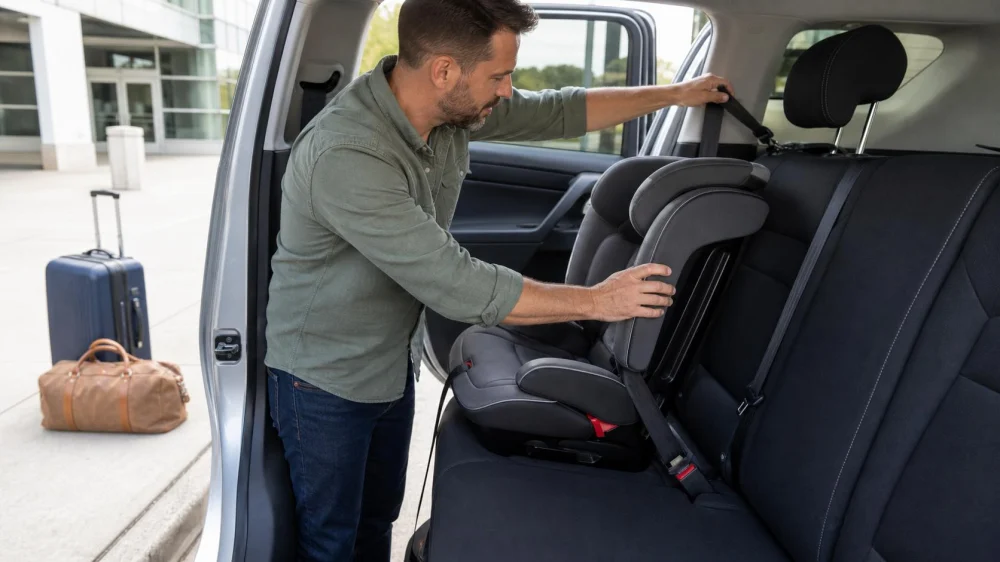
Install before leaving the lot
Park in a safe space with enough time and light. Remove luggage from the installation area. Follow both manuals step by step and use either the vehicle belt or lower-anchor system as directed; do not combine methods unless the restraint explicitly permits it.
For a forward-facing harnessed seat, use the top tether when required and route it to the correct vehicle anchor, not a cargo hook. For a rear-facing seat, set the permitted recline and keep it away from an active front airbag. Boosters generally require a lap-and-shoulder belt and correct belt positioning.
Check movement at the belt path rather than pushing the top of the seat. Confirm harness routing, buckle position, chest clip position when present, and strap tension using the seat instructions. If any step is uncertain, contact the rental company, restraint manufacturer, vehicle manufacturer, or a qualified child-passenger safety resource before driving.
Check the child and vehicle fit
The child must be within the seat's stated weight and height limits and use the correct orientation and harness setup. Bulky coats and aftermarket padding can interfere with harness fit; follow the restraint instructions for clothing and accessories.
Ensure every passenger has a usable seating position and that one restraint does not push another into an unsupported angle or cover a buckle. Do not move a child to the front seat merely to make luggage fit.
Recheck installation after the first stop, after another person moves a seat, and whenever the vehicle or restraint changes. Store unused boosters or accessories so they cannot become projectiles.
Rental child-seat checklist
- Current laws and official guidance for the route are checked.
- Child's current height and weight are known.
- Exact restraint type, availability, price, and backup plan are confirmed.
- Seat identity, date, limits, history process, labels, and instructions are available.
- No damage, missing part, contamination, expiration, or unresolved recall is present.
- Vehicle seating position and installation method are permitted by both manuals.
- Seat, harness, tether, belt path, and child fit pass the instruction checks.
- Luggage and other passengers do not interfere with the restraint.
Limitations and important notes
This guide cannot select or install a restraint for a specific child and vehicle. Product designs, state laws, airline policies, rental inventory, and recall status change. Use current official sources and both manufacturers' instructions.
Do not improvise with towels, pool noodles, locking clips, belt extenders, aftermarket harness covers, or replacement parts unless the restraint instructions specifically permit that item and use. Do not repair a cracked shell or damaged harness.
After a crash, follow restraint and vehicle manufacturer replacement criteria and the rental company's reporting process. Seek emergency help for injuries and do not continue using a seat that may need replacement.
Sources and evidence notes
The guidance reflects broad child-passenger safety practice: choose by child size and development, follow both manuals, use approved seating positions and anchors, inspect history and condition, and avoid aftermarket modifications.
Use current state highway-safety sources, the National Highway Traffic Safety Administration, the restraint manufacturer, the vehicle manufacturer, and certified child-passenger safety technicians as primary references. Rental staff roles and qualifications vary.
Frequently asked questions
Are rental car child seats guaranteed?
Policies vary. Some bookings record a request rather than reserve a specific model. Confirm with the actual pickup location and keep a backup plan.
Will rental staff install the seat?
Do not assume they will. Ask about policy and training. The driver should still understand and verify installation under the restraint and vehicle instructions.
Can I use lower anchors and a seat belt together?
Only if the child-restraint manufacturer explicitly permits it for that model and setup. Many installations use one method, plus a tether for a forward-facing harnessed seat when required.
What if the seat has no manual?
Ask for the correct official instructions and verify the exact model. If instructions and required labels cannot be established, request a different restraint rather than guessing.
Can a booster go in any back seat?
It needs a permitted position with the belt and head support specified by its manual and the vehicle manual. Some center positions lack a suitable lap-and-shoulder belt or geometry.
Conclusion and next steps
Measure the child, check the route's current rules, and call the pickup location with specific questions before travel. At the lot, inspect and install the restraint before accepting the vehicle as ready. If the seat, vehicle, or instructions do not align, use the backup plan rather than resolving it on the road.






 America's Xpress Rent A Car4.0 (197 reviews)
 Enterprise Rent-A-Car4.0 (225 reviews)
 Enterprise Rent-A-Car4.0 (221 reviews)
 Renta de carros miami0.0 (0 reviews)
 Avis Car Rental3.0 (56 reviews)
 Voy Car Rentals5.0 (6 reviews)
 How to Get from Car Rental to Providence Airport – Easy and Fast Guide
 Renting a Car in Orlando During Peak Season: What to Expect
 How to Start a Car Rental Business: A Comprehensive Guide for Beginners
 How to Get the Best Car Rental Deal in the U.S.
 Is Enterprise a Good Car Rental Company? A Comprehensive Review
 How to Return Your Rental Car on Time and Avoid Extra Charges