
Rental Car Key Fob Battery Low: Build a Backup Plan
On this page
Quick answer
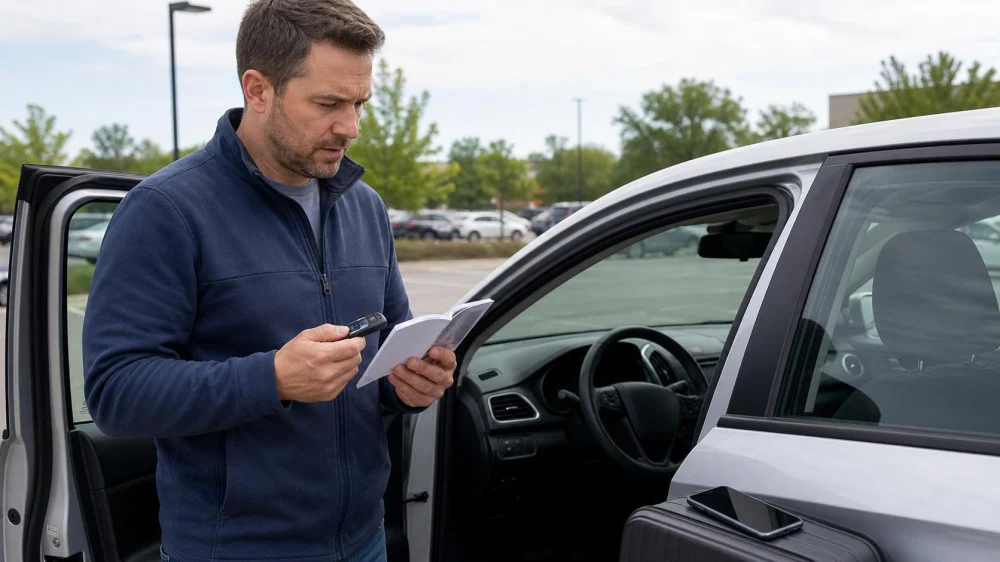
If a rental car reports a low key-fob battery, stay parked and contact the rental company before leaving when possible. Ask for a replacement fob, battery, or vehicle. If told to continue, use the owner’s manual to identify the hidden mechanical key and the model-specific backup start location, then test both with staff present. Save roadside-assistance details and do not pry open or modify the rental fob without authorization.
A key-fob backup plan is the documented way to unlock and start a vehicle when the fob battery is weak or dead. Many vehicles have a mechanical key and passive emergency recognition method, but their locations and steps vary by model and model year.
Confirm what the warning means
A dashboard message may say the fob battery is low, the key is not detected, or the key needs to be placed in a specific location. Those messages are not interchangeable. A low-battery warning suggests reduced fob power, while “key not detected” can also result from distance, an incorrect key, device damage, interference, or a vehicle-system problem.
While parked:
- Read the exact message and photograph it without including personal rental details.
- Confirm the fob belongs to the vehicle and no second rental key is nearby.
- Remove the fob from a packed bag and hold it where the manual instructs.
- Move other electronic devices or metal containers away only if the manual suggests interference could matter.
- Try the ordinary lock, unlock, and start process once.
- Stop repeated attempts if the vehicle or fob behaves abnormally.
Do not assume the car battery is failing because the fob warning appears. Conversely, a dark dashboard, slow electrical response, or repeated clicking may involve the vehicle battery rather than the fob. Contact rental assistance instead of diagnosing by guesswork.
Act before leaving the rental lot
The rental location is the easiest place to resolve the problem. Keep the vehicle in its assigned space, bring the fob and contract to the desk, and ask:
- Can you provide a tested replacement fob or another vehicle?
- Is the low-battery condition recorded on my agreement?
- Am I authorized to replace the coin-cell battery, or will staff handle it?
- Where is the correct quick-start or owner’s manual?
- What is this model’s mechanical-key entry point?
- Where must the weak fob be held for emergency starting?
- Which roadside number and rental location should I contact after hours?
- What costs or reimbursement rules apply if staff directs me to buy a battery?
Ask staff to demonstrate the backup sequence and then perform it yourself while the car is still at the lot. A verbal assurance that “it should work” is less useful than a successful test and written note.
Find the mechanical backup key
Many smart fobs contain a small removable metal key, often released by a slide or button. The driver’s door may have an exposed key cylinder or one hidden behind a trim cover. The exact release direction and cover-removal method are model-specific.
- Keep the vehicle parked and the fob over a stable surface.
- Read the manual section for keyless-entry failure or emergency entry.
- Locate the release without forcing it.
- Confirm the mechanical key is present, straight, and undamaged.
- Have rental staff show the correct door-key cylinder and trim-cover method.
- Reinsert the key into the fob exactly as designed.
The mechanical key may unlock only one door and may trigger the vehicle alarm. The manual should explain how authorized emergency starting cancels the alarm. Do not pry painted door-handle trim with a screwdriver, coin, or improvised tool.
Never use the mechanical blade for ignition unless the vehicle actually has a keyed ignition and the manual identifies that use. In many push-button vehicles, the blade is for door entry only.
Learn the backup start method
A weak fob may still be recognized when placed against the start button or held in a designated area such as a steering-column mark, cup holder, console pocket, or another location. Do not copy the location from a different model or an online video.
- Enter using the approved method and close the driver door.
- Place the transmission in Park and apply the parking brake.
- Press the brake pedal as the vehicle instructions require.
- Hold or place the fob at the exact backup recognition point.
- Press the start control using the documented timing.
- Confirm the dashboard reports a normal ready or engine-on state.
Hybrid and electric vehicles may become ready without engine noise. Use the instrument indicator, not sound, to confirm drive readiness. Keep the brake applied and do not shift until the area is clear.
After the test, switch the vehicle off and repeat once only if staff recommends it. Confirm you can lock and re-enter. If either test fails, exchange the vehicle rather than starting a trip with an unreliable backup.
What to do away from the rental location
If the warning appears during a trip, do not handle the fob or search the manual while driving. Pull into a legal, well-lit place, select Park, apply the parking brake, and secure passengers.
- Keep the fob dry and protected from impact.
- Read the vehicle manual and rental agreement while stationary.
- Call the rental company’s official roadside number from the agreement or app.
- Give your safe location, vehicle details, exact dashboard message, and whether the car currently starts.
- Follow instructions about fob-battery replacement, vehicle exchange, towing, or mobile assistance.
- Save the case number, staff name, time, and receipts.
If the vehicle is in an unsafe traffic location, prioritize people. Turn on hazard flashers when appropriate, move behind a barrier only when safe, and call 911 for immediate danger. Do not stand between vehicles or attempt a repair beside fast traffic.
Avoid preventable damage
- Do not pry apart the fob without rental-company authorization and correct instructions.
- Do not substitute a different coin cell because it looks similar.
- Do not bend battery contacts or add foil, paper, tape, or a shim.
- Do not glue, tape, or force a broken fob shell closed.
- Do not leave a coin-cell battery where a child or pet can swallow it.
- Do not expose the fob to water, high heat, or a hot dashboard.
- Do not lock the fob inside during a mechanical-entry test.
- Do not continue pushing start or lock buttons when the fob is hot, swollen, leaking, or physically damaged.
Coin-cell batteries can cause severe injury if swallowed. Keep new and used cells secured and follow local disposal guidance. For a suspected ingestion in the United States, call 911 for immediate danger and contact Poison Control at 1-800-222-1222 for expert instructions.
Document and return correctly
At return, tell staff about the warning even if the backup method worked. Hand the fob directly to an employee when possible rather than dropping a known problem into an unattended box.
- Show the photo of the dashboard message.
- Provide the roadside or desk case number.
- Return the fob, mechanical key, and every removed part together.
- Submit only authorized receipts through the stated reimbursement process.
- Ask for written confirmation that the key issue was reported.
- Do not include the fob serial number or contract details in a public review.
If using after-hours return, call before dropping the keys and follow the company’s special instructions. Document the vehicle’s location and key handoff without exposing personal or security information.
Limitations and important notes
This guide does not provide a universal emergency-entry or start sequence. Fob releases, door covers, alarm behavior, sensor locations, battery types, and authorization rules differ. Use the exact vehicle manual and rental-company instructions.
A key-fob warning can coexist with a vehicle electrical fault. Stop and get assistance for smoke, heat, burning odor, liquid leakage, swelling, repeated electrical failure, security warning, or a vehicle that will not enter a normal ready state. Do not bypass anti-theft equipment.
Frequently asked questions
Will the rental car stop running when the fob battery dies?
Behavior varies by model. Many vehicles continue operating after an authorized start but may not restart once switched off. Do not depend on that assumption; consult the manual and rental company before proceeding.
Can I replace the key-fob battery myself?
Only with rental-company authorization and the correct model-specific instructions. Unauthorized opening can damage the shell, seals, contacts, or key and create a fee dispute.
Where is the backup key hidden?
Many smart fobs contain a mechanical blade released by a small latch, but not all designs are the same. Have staff or the owner’s manual show the exact release.
Why does the car say key not detected with a new battery?
Possibilities include wrong battery orientation or type, a damaged fob, interference, an unpaired or incorrect key, or a vehicle fault. Stop repeated attempts and contact rental assistance.
Should I keep the car running at every stop?
No. Unattended idling can be illegal, unsafe, a theft risk, and prohibited by the rental agreement. Resolve the fob problem or exchange the car instead of relying on continuous operation.
Next steps
At pickup, ask staff to clear the warning or provide another vehicle. If continuation is authorized, locate and test the mechanical key and backup start method before leaving, save roadside contacts offline, and document the issue. A five-minute lot test is safer than discovering an untested emergency procedure after the car is locked in an unfamiliar place.





 Go Rentals3.0 (2 reviews)
 Enterprise Rent-A-Car4.0 (204 reviews)
 Vestige Auto LLC0.0 (0 reviews)
 Comfort: Transit Services4.0 (5 reviews)
 Enterprise Rent-A-Car4.0 (653 reviews)
 Budget Car Rental3.0 (110 reviews)
 How Much to Rent a Car Seat with Car Rental: A Complete Guide
 How to Get to SeaTac Car Rental Facility from Airport Easily
 Can You Rent a Car Seat with a Car Rental? Here's What You Need to Know
 Do Car Rental Prices Go Up Closer to the Date? Tips for Getting the Best Deal
 Does AAA Cover Car Rental Insurance? What U.S. Drivers Need to Know
 The Best Car Rental Locations for Exploring US Cities on Foot