
Rental Car Roadside Kit: Check What Is Actually Included
Table of contents
Quick answer
Do not assume a rental car has a spare tire, jack, inflator, reflective warning device, or first-aid supplies. Before a long or remote drive, ask what is included, locate it, check the owner’s manual, and save the roadside-assistance number. Carry personal essentials that travel safely and comply with airline and local rules.
Do not assume every rental is equipped alike
Modern vehicles use different tire strategies: a full-size spare, compact spare, sealant-and-inflator kit, run-flat tires, or roadside assistance without a user-serviceable spare. Equipment may also differ by trim, market, and rental location. Knowing the plan before leaving matters more than assuming you can change a tire.
The National Highway Traffic Safety Administration recommends checking the spare tire and jack and carrying a roadside emergency kit for trips. In a rental, however, the company’s instructions determine whether you should use supplied equipment or call assistance.
A five-minute equipment check
- Save support contacts. Put roadside assistance, the pickup branch, and emergency services in your phone and keep a paper copy.
- Find the tire plan. Ask staff whether the car has a spare, run-flats, or an inflator kit and where it is stored.
- Look, do not dismantle. Confirm equipment appears present without removing seals or using consumables.
- Check expiration information. If an inflator sealant shows an expired date or damage, tell staff.
- Locate safety controls. Identify hazard lights, parking brake, fuel or charging release, and the vehicle-information display.
- Read restrictions. Review the agreement and manual for towing, tire repair, off-road use, and roadside procedures.
Build a personal backup
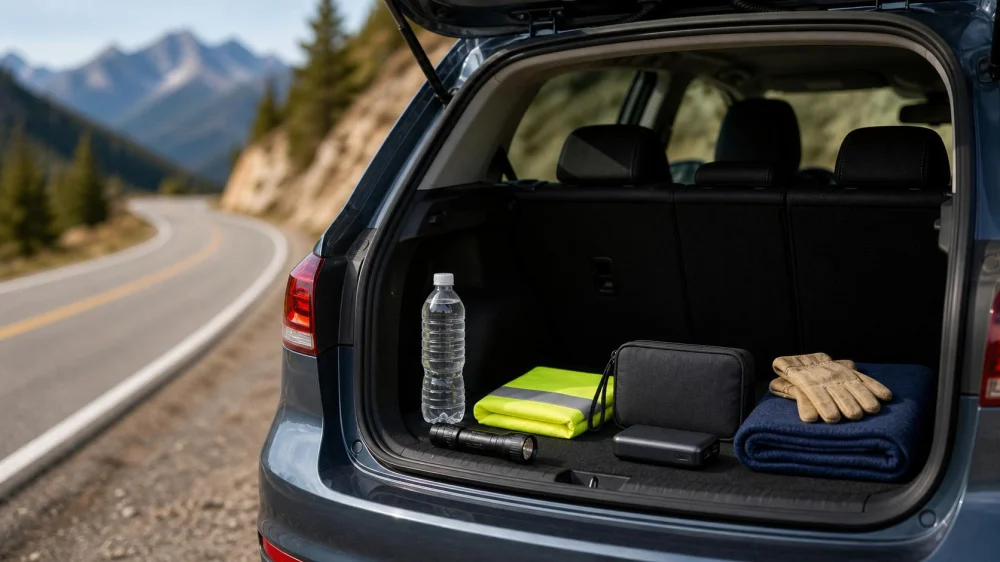
For a road trip, consider a charged phone and power bank, flashlight, reflective vest, drinking water, weather-appropriate clothing, basic first-aid supplies, paper map, and necessary medicines. NHTSA’s road-trip guidance also lists items such as jumper cables, a tire gauge, warning devices, and simple tools.
Adapt the kit to heat, cold, mountains, desert, or isolated roads. Secure every object so it cannot become a projectile. When flying, check aviation-security and airline restrictions before packing batteries, tools, liquids, or aerosols.
If you break down
- Move out of traffic only if the vehicle can be moved safely.
- Turn on hazard lights and follow local emergency guidance.
- Call emergency services for a crash, fire, injury, dangerous location, or immediate threat.
- Contact the rental company’s authorized roadside service before arranging repairs or towing.
- Do not crawl under the vehicle or attempt a roadside tire change where traffic, slope, weather, or poor visibility makes it unsafe.
- Document the location, warning messages, visible condition, and support instructions.
Limitations
An equipment check does not guarantee that a part will work, and a generic kit cannot cover every emergency. Roadside laws, emergency numbers, cellular coverage, and rental policies vary. A sealant kit may be unsuitable for some tire damage. Never make an unauthorized repair or use unfamiliar equipment without following the vehicle and rental-company instructions.
FAQ
Is a rental company required to provide a spare tire?
Requirements vary by jurisdiction and vehicle design. Ask the company what the vehicle provides and what its approved roadside procedure is.
May I buy my own tire sealant?
Do not add or use sealant without permission. Products can have compatibility limits and may affect tire-pressure sensors or repair decisions.
What if roadside assistance is an optional fee?
Ask exactly what the option covers, what support is already included, and what your insurer, card benefit, or auto club may provide. Read exclusions before deciding.
Should I change a flat myself?
Only if the rental company permits it, the correct equipment and instructions are present, and the location is safe. Calling authorized assistance is often the safer plan.
Sources and evidence notes
- NHTSA: Summer Driving and Road Trip Tips — vehicle checks, spare-tire readiness, and emergency-kit guidance.
- Federal Trade Commission: Renting a Car — rental terms, optional products, fees, and coverage context.
Next steps
Before departure, ask the counter to explain the vehicle’s tire and roadside plan, locate the supplied equipment, save support numbers, and pack a modest personal backup for the route and weather. Resolve missing or questionable items before entering the road.






 Hertz Car Rental - Pembroke Pines West - Pines Blvd3.0 (82 reviews)
 Avis Car Rental4.0 (116 reviews)
 Hertz Car Rental - Los Angeles - Westwood Boulevard3.0 (127 reviews)
 Enterprise Rent-A-Car4.0 (222 reviews)
 Hertz Car Rental - FBO - Quonset Airport Fbo - North Kingstown (NCO)0.0 (0 reviews)
 Enterprise Rent-A-Car4.0 (328 reviews)
 Is Turo Better Than Traditional Car Rental? A Detailed Comparison for U.S. Travelers
 How Much to Rent Car Seat with Car Rental – Costs, Options & Traveler Tips
 Are Car Rental Loyalty Programs Worth It? Here’s What You Need to Know
 Renting an Electric Car in the US: Charging, Costs and Tips
 How to Find the Cheapest Car Rental in the US: Insider Strategies
 How Far in Advance Should I Book a Car Rental?