
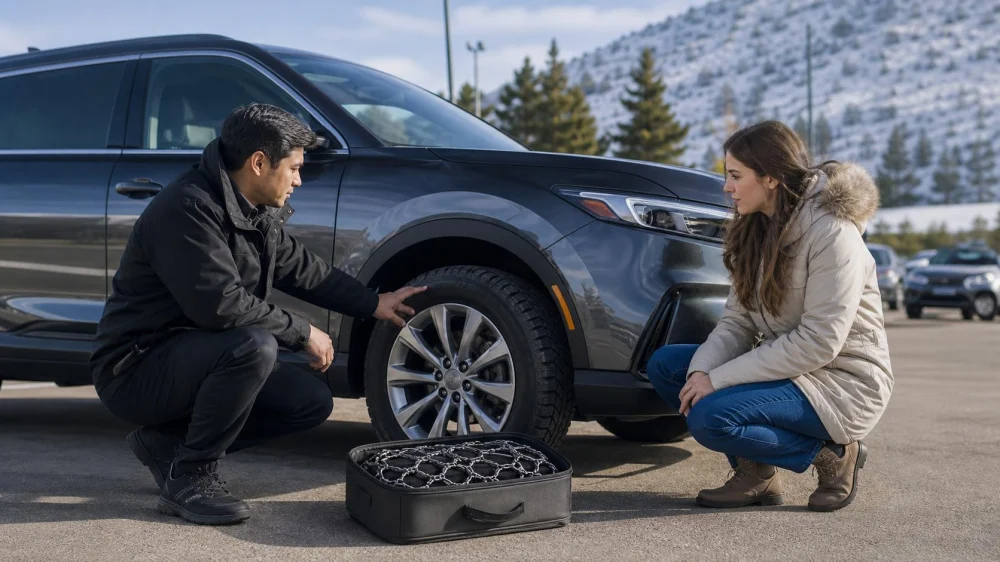
Rental Car Winter Equipment: Confirm Before the Trip
On this page
Quick answer
Before renting for winter travel, tell the company the route and likely conditions, then confirm the actual vehicle's tires, traction-device policy, legal requirements, and whether chains or cables are supplied, compatible, and permitted. A reservation class does not guarantee specific equipment. If forecasts, road controls, tire condition, or your installation skills exceed the plan, delay, reroute, or choose safer transportation.
Why it matters
Rental winter equipment includes tires, chains or cables, scrapers, and other items needed for cold, snow, or ice. Availability and legality depend on location, vehicle, road controls, and rental contract.
This guide is for U.S. rentals. State and local rules, mountain-pass controls, fleet policies, and weather change quickly. The rental company, road authority, vehicle manual, and current alerts are authoritative for the trip.
Practical checklist
- Share every state, pass, park, and high-elevation area on the planned route.
- Ask whether winter tires are installed on the specific vehicle, not merely available in the class.
- Confirm chain or cable requirements, approved type and size, clearance limits, and contract restrictions.
- Inspect tire tread, damage, pressure warning, spare or mobility kit, scraper, and washer fluid at pickup.
- Know who pays for equipment, installation, damage, roadside service, and an undrivable-weather extension.
- Save road-condition and weather sources for offline access where possible.
- Set conservative reroute and cancellation triggers before departure.
Step-by-step plan
- Research the route, not just the destination. Check elevation, pass controls, overnight parking, closures, and alternate roads.
- Call the pickup location. Central reservations may not know the exact fleet; ask staff what can be confirmed and documented.
- Review the contract. Identify prohibited roads, traction-device rules, towing limitations, and requirements for reporting a warning or damage.
- Inspect the assigned car. Photograph tires and equipment, verify size markings without claiming tread depth by sight alone, and report concerns before leaving.
- Learn controls while parked. Find defrost, washer, lights, hazard flashers, traction settings, and the owner's information.
- Respond to road controls. Install only approved equipment in a safe designated area and follow vehicle, device, rental, and authority instructions.
- Change the plan early. Do not let prepaid costs or a return deadline pressure you into a closed or unsafe route.
Save written equipment confirmation, photos, contract, receipt, roadside number, road alerts, and any staff instructions. Record changes to the vehicle or route through the rental company's approved channel.
Limits and warning signs
All-wheel drive does not eliminate braking or cornering limits, and winter tires do not make ice safe. Chains can damage vehicles when incompatible or used incorrectly. Weather can close a route even when equipment meets legal minimums.
Stop in a safe place for a tire warning, chain contact, loss of traction, poor visibility, road closure, or equipment problem. Contact the rental company and road authority; use emergency services for immediate danger. Never install traction devices in an active travel lane.
Frequently asked questions
Does AWD mean I do not need chains?
No. Road controls and rental rules may still require approved traction devices, and AWD does not shorten every stop.
Will the rental company install chains?
Do not assume so. Ask the exact location about supply, instruction, installation, liability, and roadside help.
Can I bring my own chains?
Only if they are compatible and permitted by the vehicle manual and rental contract. Clearance varies by model.
What if the booked class is unavailable?
Recheck equipment on the assigned replacement before accepting it. A larger or AWD vehicle may not meet the original winter plan.
Sources and evidence
The article reflects common winter-driving and rental planning principles: verify the actual vehicle, obey road controls, use compatible equipment, inspect at pickup, and preserve a no-go option. Current authorities and contract terms govern the trip.
Conclusion and next steps
Call the pickup branch with your exact route and ask what can be guaranteed in writing. At pickup, inspect the assigned tires and equipment before leaving. If the actual vehicle or forecast does not match the safety plan, change the route or rental.



 Enterprise Rent-A-Car4.0 (504 reviews)
 Arrowhead Viewing Spot & Historical Monument4.0 (67 reviews)
 Rent A Toyota at McGovern Toyota of Portsmouth4.0 (9 reviews)
 Hertz Car Rental - Automall Hle3.0 (80 reviews)
 Budget Car Rental3.0 (81 reviews)
 Yachty Rentals3.0 (44 reviews)
 How to Extend Enterprise Car Rental: Step-by-Step Guide for U.S. Travelers
 Do All Car Rental Companies Require a Deposit? Here's What You Need to Know
 Rental Car Additional Drivers: Authorization, Age, and Fees
 Is a Car Rental Business Profitable? Insights and Strategies for Success
 How to Get Cheap Car Rental: Tips for Finding Affordable Options
 What Does Enterprise Car Rental Insurance Cover and How It Protects You