
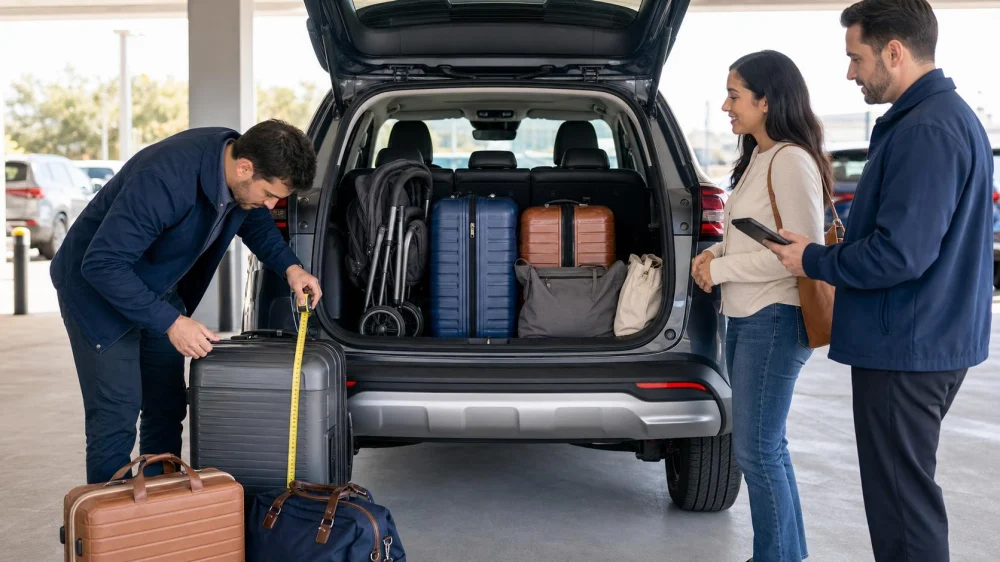
Will Your Luggage Fit? Measure Before Renting a Car
On this page
- Quick answer
- Why a rental class is not a cargo guarantee
- Build a real luggage inventory
- Measure the difficult items
- Protect passengers and visibility
- Test the vehicle at pickup
- Choose the right class
- Booking checklist
- Important notes and limitations
- Evidence and source notes
- Frequently asked questions
- Next steps
Quick answer
Count people and every hard-to-compress item, then measure the largest suitcases, stroller, mobility aid, sports case, or cooler. Treat online bag icons as estimates because the actual model can vary. Choose enough cargo room without folding seats needed by passengers, blocking the driver’s view, or leaving heavy items unsecured. Test the real vehicle before leaving pickup.
Why a rental class is not a cargo guarantee
Rental reservations commonly promise a vehicle category and show an example model. Another car in that class may have a different hatch opening, trunk shape, spare-tire layout, battery placement, or rear-seat angle. Stated cargo volume also does not show whether a long, rigid suitcase fits through the opening.
Ask whether a specific model can be confirmed, but plan for category variation. If cargo is critical, arrive with time to inspect alternatives rather than discovering the problem after the counter closes.
Build a real luggage inventory
- One line for every suitcase, backpack, personal item, and shopping bag.
- Stroller, child-seat base, portable crib, or diaper bag.
- Wheelchair, walker, cane, or other mobility equipment.
- Skis, golf bag, musical instrument, bicycle case, or work equipment.
- Cooler, pet carrier, and expected items acquired during the trip.
Do not count soft bags as “free” space. They still need a secure location and can expand. Keep essential medicine, identification, and valuables in a personal bag that remains accessible.
Measure the difficult items
- Measure length, width, and depth at the widest points, including wheels and handles.
- Mark which items cannot be folded, tilted, checked, or placed on their side.
- Photograph the group of packed items for pickup comparison.
- Ask for cargo-opening and behind-seat dimensions when the rental location can provide them.
- Leave space for cables, emergency kit, parcel cover, and normal seat position.
A total-volume calculation can be misleading because irregular shapes leave unused gaps. The largest rigid item and the cargo opening are often the deciding constraints.
Protect passengers and visibility
Do not plan to place a hard suitcase on a passenger’s lap, in a footwell needed for safe seating, or loose above the seatback. Child restraints need their full installed space and approved seating position. The driver needs clear windows, mirrors, controls, and rear visibility appropriate to the vehicle.
Keep heavy items low and forward in the cargo area and use the vehicle’s approved tie-down points when available. Do not overload the vehicle; passengers, luggage, and accessories all count toward its payload limit.
Test the vehicle at pickup
- Open the trunk or hatch and check the height and shape of the opening.
- Confirm every passenger seat can remain in its safe position.
- Install child restraints according to their and the vehicle’s instructions before loading around them.
- Load the largest rigid item first without forcing trim or glass.
- Confirm the hatch closes freely and nothing presses against it.
- Secure the load and check visibility before leaving.
Choose the right class
A larger class is useful when it solves a measured constraint, not simply because it sounds spacious. A sedan trunk hides luggage well but may have a narrow opening. A hatchback or SUV can accept taller items but luggage may be visible unless a cargo cover fits. A minivan may be best for several passengers plus bulky gear.
If only one oversized item causes the problem, compare lawful roof, ski, or bicycle equipment supplied or approved by the rental company. Do not attach personal racks or fold seats in ways the agreement forbids.
Booking checklist
- Passenger count, including child restraints.
- Exact luggage and equipment inventory.
- Dimensions of the largest rigid items.
- Need for concealed cargo, accessibility, or a low loading height.
- Vehicle class and “or similar” wording.
- Pickup-location alternatives and upgrade cost.
- Payload, rack, seat-folding, and pet rules.
Important notes and limitations
Online specifications, bag icons, and example vehicles are planning aids, not guarantees. The rental agreement, actual vehicle label and manual, restraint instructions, and staff-approved equipment control. Do not exceed payload or seat limits, disable safety equipment, or obstruct required visibility to make luggage fit.
Evidence and source notes
The method relies on primary trip-specific sources: the reservation’s exact class terms, the assigned vehicle’s cargo and payload information, child-restraint and mobility-equipment instructions, and the rental location’s accessory policy. These are more reliable than generic “number of bags” claims for a particular booking.
Frequently asked questions
Are rental-car luggage icons accurate?
They are estimates for a category. Model substitution, luggage shape, and passenger-seat position can change actual fit.
Can I fold one rear seat with passengers beside it?
Only if the vehicle manual permits it, remaining passengers and restraints fit safely, and cargo cannot shift into the occupied area.
Is an SUV always better than a sedan for luggage?
No. SUVs often have flexible openings, while some sedans offer deep concealed trunks. Measure the limiting item and consider privacy and loading height.
What if luggage does not fit at pickup?
Do not drive with an unsafe load. Ask about another class, remove nonessential items, or arrange approved transport for the excess.
Should valuables stay in the cargo area?
Avoid leaving valuables in a parked vehicle. Keep essential documents, medicine, and high-value items with you when practical.
Next steps
Lay out every packed item, photograph the group, measure the largest rigid pieces, and reserve around the real constraint. At pickup, load-test the assigned vehicle before accepting it and driving away.





 PUSH 2 START LLC0.0 (0 reviews)
 Elite SS Rentals, LLC5.0 (5 reviews)
 TeslaRents4.0 (11 reviews)
 Hertz Car Rental - Winder Ga3.0 (50 reviews)
 MPH Club5.0 (4 reviews)
 Enterprise Rent-A-Car4.0 (169 reviews)
 Renting a Car for Your US National Park Adventure: Top Tips
 How to Make Your Car Rental Experience Smooth and Stress-Free
 Renting a Car for a Business Conference: What to Look For
 What is the Best Car Rental Company for Your Next Trip?
 Best Fuel Saving Tips When Driving a Rental Car
 How to Extend Budget Car Rental Without Stress