
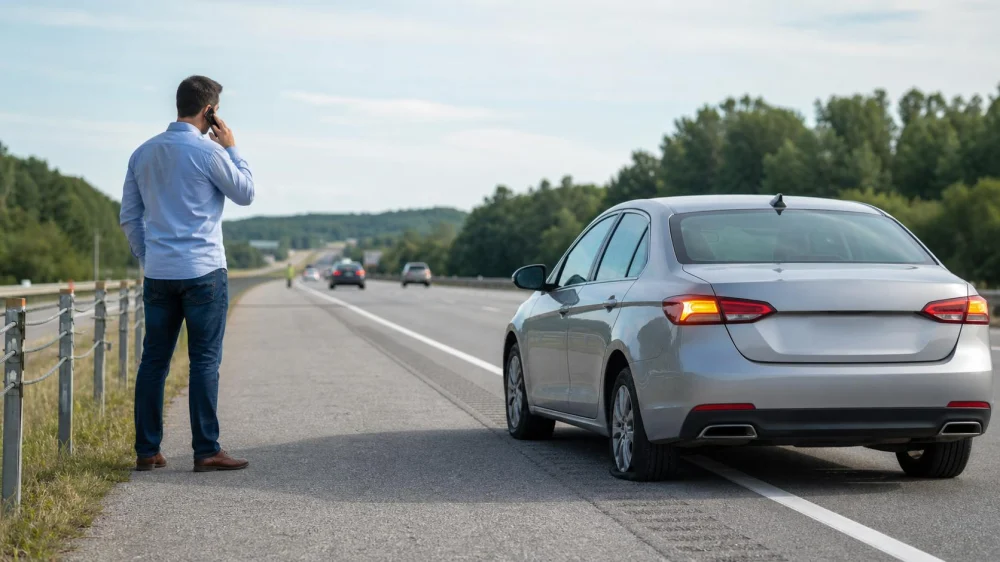
Flat Tire in a Rental Car: Get Safe, Document, and Call
On this page
Quick answer
If a rental tire suddenly loses pressure, hold the steering wheel firmly, ease off the accelerator, avoid abrupt steering or hard braking, and move to the safest available stopping place once the vehicle is controlled. Turn on hazard lights, keep occupants away from traffic, and call emergency services if the location is dangerous. Then contact the rental company's roadside channel before changing, repairing, towing, or replacing anything.
Protect people before resolving the contract
A flat tire creates two separate problems: immediate roadway risk and responsibility under the rental agreement. NHTSA tire guidance emphasizes maintaining control and stopping safely after tire failure. FTC rental guidance notes that roadside assistance may be included or sold separately and that coverage details vary. Your first priority is a safe location; documentation and authorization follow only when they can be handled without traffic exposure.
This guide is for U.S. renters facing tire-pressure loss or visible tire damage. It does not replace emergency directions, the vehicle manual, roadside training, or the rental contract. Road, weather, traffic, vehicle, disability, and security conditions can make waiting inside or leaving the vehicle safer in different situations.
Practical checklist
- Grip the wheel, ease off the accelerator, avoid abrupt inputs, and stabilize the vehicle.
- Pull as far from moving traffic as safely possible and activate hazard lights.
- Call 911 when the vehicle or occupants remain exposed to immediate danger.
- Use the rental agreement, key tag, or official app to reach authorized roadside help.
- Report location, vehicle, tire position, warning lights, damage, passengers, and safety needs.
- Photograph the tire and surroundings only from a safe position and without entering traffic.
- Do not use sealant, jack the car, authorize a tow, or buy a tire without rental-company approval.
- Save case numbers, provider details, receipts, messages, and replacement-vehicle arrangements.
Step-by-step plan
- At the first sign of vibration, pull, warning, or pressure loss, reduce speed smoothly and avoid panic braking.
- Choose the safest reachable stopping point; do not damage the wheel by continuing merely to reach the original destination.
- Account for all occupants and move them away from traffic only when it is safer to exit.
- Contact emergency services for an exposed lane, injury, fire, collision, or other immediate hazard.
- Call the rental company's official roadside number and follow its instructions about towing or a spare.
- Document the condition and authorization without touching a hot, damaged, unstable, or traffic-side wheel.
- After service, confirm where to take the vehicle, whether driving is permitted, and how charges and exchanges will be handled.
Record time, road and direction, precise location, speed and symptoms before stopping, dashboard warnings, tire position, visible damage, weather, photos, police or roadside case numbers, rental contacts, instructions, tow destination, receipts, and replacement agreement.
Limits and important notes
A tire-pressure warning does not identify the cause, and adding air may be unsafe when there is puncture, sidewall damage, heat, vibration, or rapid loss. Compact spares have vehicle-specific limits. A jack should never be used on unstable, sloped, soft, or traffic-exposed ground. Personal roadside or card benefits may not authorize work under the rental contract.
Call 911 for a crash, injury, fire, smoke, dangerous lane blockage, threatening situation, or location where occupants cannot remain safe. Tell rental roadside support if a child, older adult, disabled passenger, extreme temperature, or remote area changes urgency. Do not drive when the tire is visibly flat or damaged, the wheel contacts the road, control is impaired, or the provider has not authorized continued travel.
Frequently asked questions
Should I change the rental tire myself?
Only if the rental company authorizes it, the vehicle has suitable equipment, the manual permits it, and the location and your ability make the task safe. Roadside help is often the better choice.
Can I drive slowly on a flat to reach a station?
Do not assume so. Continuing can impair control and damage the tire or wheel. Stop safely and get authorized guidance.
Who pays for roadside service or the tire?
It depends on the contract, cause, purchased coverage, and provider terms. Request authorization and keep records rather than guessing at the roadside.
What photos should I take?
Only from a safe location: tire position and condition, wheel area, dashboard warning, vehicle location, and relevant surroundings. Never step into traffic for evidence.
Sources and evidence
NHTSA TireWise and tire-failure guidance emphasize firm steering, gradual slowing, safe stopping, correct vehicle-specific pressure, and professional inspection for damage. The FTC's Renting a Car guide explains that roadside assistance inclusions, fees, and flat-tire coverage vary. The vehicle manual, rental agreement, and authorized roadside provider control the actual procedure.
Conclusion and next steps
Save the official roadside number before driving away at pickup. If a tire fails, stabilize the car and protect occupants before handling documentation. Get authorization for service, preserve the full timeline, and confirm replacement, towing, and payment instructions in writing whenever possible.




 TC Exotic Rental Cars5.0 (3 reviews)
 Le'xotic Car Rental5.0 (1 reviews)
 Enterprise Rent-A-Car3.0 (407 reviews)
 Enterprise Rent-A-Car3.0 (76 reviews)
 Enterprise Rent-A-Car4.0 (277 reviews)
 Top Shine Fleet5.0 (3 reviews)
 How to Save Money on Long-Term Rentals
 Which Car Rental is Better? A Complete Comparison of Top Options
 Is Budget Car Rental Worth It? Exploring the Pros and Cons
 Is Endeavor a Car Rental Company? Find Out Here
 Renting a Car in Cincinnati Ohio: Cost Guide and Smart Budget Tips
 Top 10 Car Rental Locations Near Popular US Tourist Attractions