
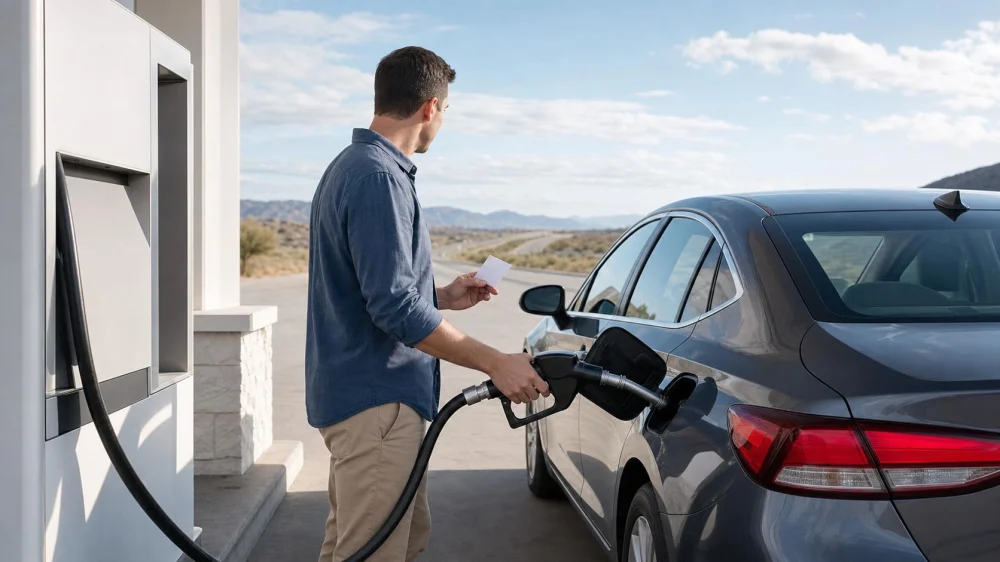
Rental Car Fuel Policies: What to Compare Before Pickup
On this page
Quick answer
Compare rental fuel policies by asking what level you must return, how missing fuel is priced, whether a service charge applies, whether prepaid fuel is refundable, and what evidence the company accepts. Full-to-full is often easiest to verify when you can refuel nearby; prepaid fuel may favor convenience but can charge for fuel you leave unused.
This guide is for U.S. car renters comparing gasoline, diesel, hybrid, or electric reservations. Terms and prices vary by company, location, vehicle, membership, and contract. The signed rental agreement and the pickup record control your transaction, so confirm every important condition before accepting the keys.
Common fuel policy types
A rental car fuel policy states how much fuel or battery charge the vehicle has at pickup, what level is required at return, and how the rental company calculates any shortfall. Similar marketing names can hide different rules, so compare the actual contract language.
Full-to-full
You receive the vehicle at or near full and return it at the required full level. This is best for renters who can find a suitable station shortly before return and keep a receipt. The risk is a refueling charge if the gauge does not meet the contract standard.
Prepaid fuel
You pay in advance for a tank or fuel option and usually may return without refilling. It can reduce return-day stress, but unused fuel commonly stays with the vehicle and may not be refunded. Compare the total option price, taxes or fees, and whether it is based on the tank capacity rather than expected use.
Return-as-received
You return the vehicle at the same recorded level as pickup. This can work, but partial gauge marks are harder to reproduce than full. Photograph the gauge and verify the starting level on the agreement before leaving.
Company refueling or pay-on-return
The company replaces missing fuel after return and charges the contract rate, sometimes with a service component. This is convenient but may cost more than refueling yourself. Ask whether the rate is per gallon, based on an estimated amount, or combined with another charge.
Some rentals use different rules for diesel, flexible-fuel vehicles, plug-in hybrids, or electric vehicles. Never put fuel into a vehicle until you confirm the required type on the vehicle and agreement.
How to compare the real cost
Do not compare only the advertised daily rate or a single fuel price. Build the likely total for your route and return conditions.
- Estimate driving. Map the likely miles, including airport or hotel transfers, side trips, and the return station.
- Identify the vehicle class. You may reserve a class rather than an exact model, so fuel economy and tank size are uncertain until pickup.
- Read the fuel option price. Ask whether tax, facility charges, or service fees apply and whether unused fuel receives any credit.
- Check the shortfall formula. Record the rental company's price per gallon or other calculation and whether a separate refueling service charge applies.
- Value return time realistically. A late flight or early return can make convenience important, but do not pay for convenience you are unlikely to use.
- Check nearby stations. Look for current operating hours, access direction, accepted payment, fuel type, and a safe route to the return location.
A useful decision rule is to choose full-to-full when the starting tank is verifiably full, you expect to use only part of it, and you can refuel conveniently. Consider prepaid fuel when you expect to use most of the tank and the return schedule makes refueling difficult, after confirming the complete price and no-refund rule.
The Federal Trade Commission advises consumers to compare the total rental cost and notes that company-provided replacement fuel can cost more than filling the vehicle at a local station. Its rental car consumer guide also covers other fees that can change the final bill.
Fuel checks at pickup
Resolve a starting-level error before driving away. The longer you wait, the harder it can be to show that the pickup record was wrong.
- Match the vehicle number or license plate to the agreement without publishing those details.
- Start the vehicle on level ground and photograph the fuel or battery gauge with the odometer.
- Confirm the gauge level printed or displayed on the rental agreement.
- Ask staff to correct a mismatch in writing before departure.
- Check whether the vehicle requires gasoline, diesel, premium fuel, another fuel, or charging.
- Find the fuel-door release and determine which side the door is on.
- Keep the rental location's approved contact details and after-hours instructions.
Do not rely only on a dashboard range estimate. Range changes with driving style, traffic, temperature, accessories, and terrain. The contract's stated gauge or charge requirement is the relevant return target.
If the vehicle shows a warning, a damaged fuel cap, a strong fuel smell, or a charge-port problem, do not attempt a repair. Photograph the condition from a safe position and contact the rental company.
A low-stress return plan
Plan the fuel stop before the return day. Save two station options so a closure, blocked entrance, or out-of-service pump does not force a last-minute detour. Allow time for traffic and for the gauge to update after refueling.
- Confirm the required return location and deadline.
- Use the correct fuel type and stop when the pump automatically shuts off; do not overfill.
- Keep the itemized receipt showing station, date, time, quantity, and amount.
- Photograph the dashboard gauge and odometer on level ground.
- At the return lane, photograph the vehicle position and final gauge when permitted and safe.
- Ask for a closed rental receipt or review the electronic receipt promptly.
A receipt from a distant station may not prove the vehicle met the required level at return. Ask whether the contract requires refueling within a certain distance and whether a receipt must be presented. Do not fabricate or alter evidence.
For after-hours returns, follow the location's instructions about parking, key drop, photos, and when the rental remains your responsibility. A key in a drop box may not be the same as a completed check-in.
Electric and hybrid rental differences
Electric-vehicle return rules use battery charge rather than gallons. Ask for the required percentage or range, the allowed tolerance, the shortfall charge, idle or charging fees, compatible networks, payment method, cable requirements, and whether the rental includes charging benefits.
Do not assume a charger shown on a map is available, compatible, operational, or accessible at the time you need it. Build a return plan with a backup charger and enough time for charging speed to slow near a high state of charge.
A plug-in hybrid may need both fuel and battery checks. Clarify whether the battery must be returned at a specified level in addition to the fuel tank. For a conventional hybrid, follow the gasoline rule and do not search for a charge port that the vehicle does not use.
Photograph the starting and ending charge level, estimated range, and any charging equipment supplied with the vehicle. Never use an adapter or extension setup the rental company or charging provider does not permit.
Important limits and disputes
Fuel prices, station hours, charging availability, taxes, and rental policies change. Verify them close to the trip. A verbal counter explanation should be reflected in the agreement or another written confirmation.
If you see an unexpected fuel charge, compare the pickup record, signed fuel option, return photos, fuel receipt, final invoice, and contract formula. Contact the rental company promptly through its official channel and ask for an itemized explanation. Preserve the original files and correspondence.
Do not drive while distracted by searching for fuel or charging. Stop in a safe legal place to review maps or contact the company. If you put in the wrong fuel, do not start the engine; contact the rental company's roadside process immediately.
Frequently asked questions
Is prepaid fuel always more expensive?
No universal answer applies. Compare the total prepaid price with the amount you realistically expect to use and the cost and time of refueling. The value falls when substantial paid fuel remains in the tank without a refund.
Does “full” mean the needle touches the full mark?
Use the rental contract's standard and the company's recorded level. Gauges vary. Photograph the pickup display, ask staff to document a mismatch, and refuel close to return when required.
Should I keep the gas receipt?
Yes. Keep it with dashboard and return photos until the final bill and card activity are settled. Some agreements specifically require a nearby fuel receipt.
Can I return an EV at any battery level?
Only if the contract permits it. Many agreements set a required charge level or assess a fee below a threshold. Confirm the exact percentage, tolerance, and charging-cost formula.
What if the pickup tank is not full?
Do not accept a full starting level on the record. Photograph the gauge on level ground and ask the company to correct the agreement before leaving.
Sources and evidence notes
The consumer-cost principles in this guide align with FTC advice to compare the full rental price, review fees, and understand fuel charges. Specific fuel, EV, evidence, and return requirements come from the individual reservation and signed agreement. No price, fuel economy, refund, charger, or station availability is assumed.
Conclusion and next steps
Choose a rental fuel policy by comparing the complete price, expected use, return schedule, shortfall formula, and evidence requirements. At pickup, correct the starting record and confirm the energy type. Before return, use a backup refueling or charging plan and preserve receipts and dashboard photos. The simplest policy is the one you can satisfy and document without rushing.






 Hertz Car Rental - North Las Vegas - E Craig Road3.0 (296 reviews)
 Avis Car Rental3.0 (2025 reviews)
 Avis4.0 (6 reviews)
 Lake Lure Jeep Rentals5.0 (21 reviews)
 Seven Worlds Plus4.0 (21 reviews)
 ACE Rent A Car4.0 (672 reviews)
 Renting a Car in Jackson Hole Wyoming: Travel Guide
 Best Rental Cars for Mountain Driving: Safe and Reliable Options
 How to Compare Car Rental Prices Across Platforms
 Does Payless Car Rental Accept Debit Cards?
 Is Thrifty Car Rental Good? A Comprehensive Review
 Does My Credit Card Have Car Rental Insurance? Complete Guide for U.S. Drivers